
Deafheaven: New Bermuda
Sunbather made the world recognize Deafheaven, but their follow-up is where they cemented their place in black metal history.

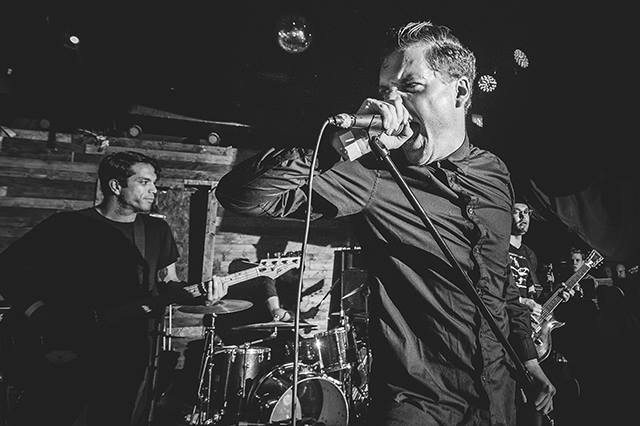
Metal might be the redheaded stepchild of music genres, but every now and then it breaks through to the mainstream. Case in point: Black Sabbath, Metallica, AC/DC, and the like. This might ruffle some feathers with purists, but even those bands have some pop appeal.
Black metal, however, is a different ballgame. Emerging from Europe in the early 1980s, bands like Venom, Mercyful Fate, and Bathory inadvertently pioneered a new subgenre of heavy metal—taking what they loved about the genre (speed, ferocity) and layering in overtly Satanic imagery.
Then came the second wave in Norway in the early ’90s. The first wave treated devil talk like theater, but the Norwegians weren’t joking around. Between murders, church burnings, and pig heads on stakes at shows, the stories sound like something ripped from a horror flick—but it all happened.*
Like any genre, black metal kept evolving, which brings us to the 2010s, when bands like Liturgy and Wolves in the Throne Room (not European, but key to the movement) were reshaping the genre.
And of course, we can’t talk about this revival without acknowledging Deafheaven, formed by vocalist George Clarke and guitarist Kerry McCoy. They took black metal’s blueprint and stretched it in every direction, pulling in shoegaze, post-rock, and even indie rock. 2013’s Sunbather was a total game-changer. It had the shrieks, the blast beats, the long epics—but what set it apart was its brightness, thanks to McCoy’s love of Kevin Shields (My Bloody Valentine) and Johnny Marr (The Smiths). For all its heaviness, Sunbather is packed with enough sun-soaked guitars that make it one of the most unique black metal albums I’ve ever heard.
That said, 2015’s New Bermuda, the follow-up to Sunbather, is my personal favorite.
Let’s get into it.
New Bermuda suffers from post-breakout syndrome—but it shouldn’t.
It’s a tale as old as time: a band releases a breakout record, it becomes a critical darling, and everything afterward lives in its shadow. Not because the follow-ups aren’t good or worth your time, but because the expectations become impossible to meet.
That’s exactly what happened with Deafheaven. Google “Deafheaven Sunbather” and you’ll find endless think pieces—not just from when it dropped in 2013, but retrospective essays still dissecting its influence and legacy. Nothing can quite live up to it, and that’s unfair.
But just because Sunbather was a game-changer doesn’t mean the rest of Deafheaven’s catalog should be ignored, especially New Bermuda.
New Bermuda is a tighter, more focused record.
Sunbather had seven tracks: four with vocals and three instrumentals, sequenced so that every “vocal” song was broken up by an instrumental. Nothing wrong with that, but on New Bermuda, the band went with five songs that cut straight to the chase, getting to the point without ever feeling rushed.
The heavy moments hit hard.
Opener “Brought to the Water” doesn’t waste a second. It explodes out of the gate with blast beats and chugging guitars before George Clarke storms in, shredding your eardrums with high-pitched shrieks straight out of Emperor’s playbook. Eventually, the chaos melts into something more melodic, with Kerry McCoy weaving in fluttering guitars that carry the instrumental sections.
If “Brought to the Water” isn’t enough evidence that Deafheaven was back with a vengeance, the follow-up “Luna” seals it. It kicks off with chugging guitars and blistering blast beats before Clarke unleashes his shrieks, barely letting up until six minutes into this ten-minute epic. Add in the relentless double-kick drumming, and the song feels like it’s coming at you in waves of pure fury. The tempo dips here and there, but the rage never fades.
Then comes “Baby Blue,” the slowest of slow burns. It opens with sun-soaked, reverb-heavy guitar picking, anchored by Daniel Tracy’s intricate drumming. For over three minutes, it shimmers and builds—then detonates into Deafheaven’s take on sludge metal. The song peaks midway through with a scorching McCoy lead, a highlight not just of the track, but of New Bermuda as a whole. The closing minutes are hypnotic: thick, chugging riffs locked in with the bell of the ride cymbal, Clarke’s screams, and Tracy’s machine gun double-kicks.
And then there’s “Come Back,” which opens with what might be the most aggressive moment on the album: blast beats hammered out in triplets. From there, the band leans into its darkest side, with McCoy and Shiv Mehra doubling up on eerie leads that drip with unease. Deafheaven rarely channel the overt “evil” essence of early black metal, but here, it’s unmistakable.
In the end, it comes down to how Deafheaven can balance intensity with tenderness, and New Bermuda doesn’t disappoint.
There’s a time and a place for aggression, but too much of a good thing can lead to burnout. If you’re going to perform eight-, nine-, or ten-plus-minute songs, it’s important that the music ebbs and flows. And if it isn’t obvious by now, Deafheaven are masters at this.
The final moments of “Brought to the Water” are comprised solely of a beautiful piano chord progression that softens as the song comes to a close. The instrumental section of “Luna” and the back half of “Come Back” sound like Explosions in the Sky—dreamier guitars on the latter, but the point stands.
And the closing minutes of the final track, “Gifts for the Earth,” wrap New Bermuda perfectly with reverb-heavy leads, acoustic guitar, and pianos. It’s so diametrically opposed to the way the album begins that it’s hard to believe it’s the same band—a beautiful ending to one hell of a ride.
Since New Bermuda, Deafheaven have made it clear they’re not interested in being boxed in as “just” a black metal band with a knack for melody. The albums that followed—Ordinary Corrupt Human Love and Infinite Granite—pushed even further away from black metal, with the former leaning even more into post-rock and the latter abandoning black metal almost entirely. Then, earlier this year, they circled back with Lonely People with Power—their meanest record since New Bermuda. It feels like a return to form, but, knowing them, it’s probably just a temporary visit.
I think the best word to describe Deafheaven is “fearless.” Here’s a band that came up in a genre that rarely cracks the mainstream, took flak for not being “real” metal, and still stuck to their vision. They might not wear corpse paint or torch churches, but they can go toe-to-toe with black metal’s greats—New Bermuda is the proof.
I’ve added some of my favorite Deafheaven songs to my Spotify playlist—check it out below!
*The book Lords of Chaos: The Bloody Rise of the Satanic Metal Underground tells the full story of black metal’s second wave in Norway—a fascinating read regardless of your fandom.